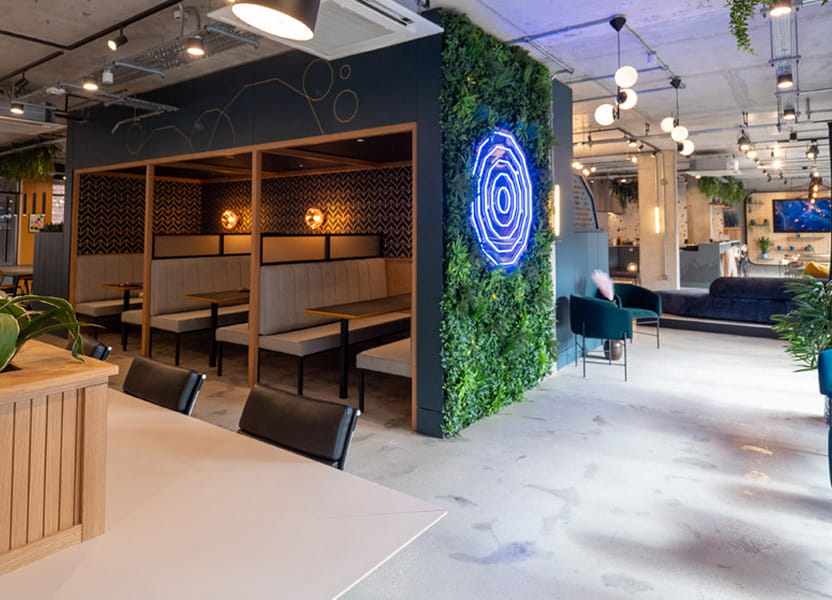
Not sure where to start with a Manchester office search?
Follow this step-by-step process to set your brief, work out your budget, choose an area, shortlist offices, arrange viewings and negotiate the right deal.
Finding an office in Manchester can quickly become more complicated than expected.
You start searching and find serviced offices, coworking spaces, managed offices and traditional leases across the city centre, Ancoats, Spinningfields, NOMA, MediaCity and beyond.
Then come the questions:
Which areas should I shortlist?
How much should we actually spend?
How much office space does a team of 10 need?
Which providers should I contact?
What is included in the price?
The easiest way to make the search manageable is to work out your requirement before you start looking at individual offices.
Start with your team, budget and working pattern. Narrow the search to two or three areas. Decide which facilities genuinely matter. Then compare a small number of offices against the same criteria.
If you would rather have someone search the Manchester market for you, Manchester Offices has helped more than 10,000 businesses find workspace and says 92% of clients secure a space within four weeks. Its search service is free to businesses.
Start your Manchester office search

Step 1: Start with why you need an office
Before deciding between Ancoats and Spinningfields, work out what the office needs to achieve.
Are you looking because:
- the team has outgrown working from home?
- employees need somewhere to collaborate?
- clients need somewhere professional to meet you?
- you are opening a Manchester base?
- your current office is too small?
- your lease is ending?
- you need somewhere quickly?
- the team only needs a shared base a few days a week?
A founder who wants somewhere for five people to meet twice a week has a very different requirement from a 30-person company looking for a permanent headquarters.
Start with the business problem.
Then find the office that solves it.
Step 2: Work out how many people actually need space
Do not automatically search for one desk per employee.
Ask:
How many people will actually be in the office on the busiest normal day?
If you have 20 employees but only 12 usually attend because of hybrid working, a 20-desk office may be unnecessary.
For smaller teams, current Manchester office listings show a large supply of six, eight and ten-person offices with flexible terms, including options from one to 12 months depending on the provider.
A simple starting point
1–5 people
Consider coworking or a small private serviced office.
6–10 people
A private office usually becomes more useful if the team works together regularly.
11–20 people
Look for strong meeting-room and breakout facilities.
20–50 people
Compare serviced and managed options.
50+ people
Consider larger managed suites, whole floors and traditional leases.
Also think about growth.
If you have eight employees now but expect 12 within six months, choose somewhere that can either fit a few additional desks or move you into a larger suite.
Step 3: Set a realistic monthly budget
Manchester is significantly cheaper than London, but prices still vary widely by neighbourhood and specification.
Around £400 per desk per month is a useful 2026 city-wide planning benchmark.
Most mainstream flexible offices sit between approximately £250 and £500 per desk, with lower-cost out-of-centre options and premium Grade A workspace outside that range.
At the £400 benchmark:
5 people = around £2,000 per month
10 people = around £4,000 per month
20 people = around £8,000 per month
50 people = around £20,000 per month
These are planning figures rather than quotes.
Do not compare the desk price alone
A £350 desk is not automatically better value than a £400 desk.
One office may include meeting rooms, furniture, internet and 24/7 access.
Another may charge extra for facilities your team uses every day.
Check:
- VAT
- meeting-room costs
- parking
- deposits
- printing
- storage
- internet upgrades
- furniture
- additional access cards.
The important figure is the expected total monthly cost, not just the headline desk rate.
For a fuller breakdown, see the Manchester Office Cost & Price Index 2026.
Step 4: Choose two or three Manchester areas
Trying to search the entire Manchester market at once usually creates too many options.
Choose two or three locations based on commute, business needs and budget.
Manchester City Centre
A strong all-round option with excellent transport and the largest range of office providers.
Spinningfields
Popular with finance, legal, professional-services and client-facing businesses.
Ancoats
A strong choice for startups, technology businesses, agencies and creative companies.
Northern Quarter
Suited to creative, digital and independent businesses that want a more informal environment.
NOMA
Modern workspace close to Victoria station, with growing technology and business communities.
Oxford Road
Particularly useful for companies connected to universities, technology, research and innovation.
Salford Quays and MediaCity
Often better value than premium central locations and particularly relevant to media, digital and creative businesses.
Current Manchester planning rates range from around £180 per desk in airport or out-of-centre locations, approximately £250 around Salford Quays and MediaCity, £350 around Ancoats and Oxford Road, £375 around Spinningfields and £500+ in premium new Grade A buildings.
Step 5: Make a must-have list
Split your requirements into:
Must have
Nice to have
Doesn’t matter
Your list could include:
- private office
- number of desks
- meeting rooms
- 24/7 access
- phone booths
- natural light
- parking
- bike storage
- showers
- air conditioning
- company branding
- private kitchen
- reception
- accessibility
- room to grow.
This prevents an attractive building from distracting you from something the team genuinely needs.

Step 6: Decide which type of office to search for
Coworking
Best for founders, very small teams and businesses with irregular attendance.
Serviced office
A furnished private office with most day-to-day building services already arranged.
This is often the easiest option for small and growing teams.
Managed office
A more private and customisable workspace with greater control over branding, meeting rooms and layout.
Traditional lease
The greatest level of control, but also the longest commitment and highest operational responsibility.
For a full comparison, see Serviced vs Managed vs Coworking vs Traditional Lease: Manchester Office Guide.
Step 7: Write a simple office brief
A useful Manchester office brief might look like this:
Team size: 10 people
Expected growth: 12–15 within 12 months
Preferred areas: Ancoats, NOMA or Northern Quarter
Budget: Up to £4,500 per month
Move-in: Within six weeks
Term: Ideally 6–12 months
Office type: Private serviced office
Must have: Meeting rooms, phone booths and 24/7 access
Nice to have: Showers and bike storage
Working pattern: Team in three days per week
Growth: Ability to move into a larger suite
That is enough to turn a broad search into a useful shortlist.
Where Manchester Offices helps
If you use Manchester Offices, this is where you can hand over the brief.
Its advisers use your team size, budget and preferred location to shortlist suitable spaces, arrange viewings and support the negotiation. The service is free to businesses.
Manchester Office Search & Broker Service
Step 8: Shortlist three to five offices
You usually do not need to view 15 buildings.
Aim for around three to five strong options.
Compare:
- monthly cost
- desks
- location
- walk from station
- minimum term
- deposit
- meeting rooms
- phone booths
- 24/7 access
- furniture
- parking
- showers
- bike storage
- branding
- growth options
- move-in date.
Using the same criteria makes the decision much easier.
Which providers should I shortlist?
Start with your requirement rather than the operator.
Instead of asking:
Which Manchester office provider is best?
Ask:
Which providers currently have offices that match our team, location, budget and contract requirement?
Different providers are better suited to different situations.
Some offer low-cost small offices.
Others provide premium client-facing space.
Some are strongest for startups and community.
Others focus on larger managed offices.
A broker can compare those options without limiting the search to one workspace brand.
Step 9: View the offices properly
During a viewing, imagine a normal working day.
Ask:
Will everyone fit comfortably?
Where will calls happen?
Are meeting rooms actually available?
Is there enough natural light?
How noisy is the building?
Does the commute work?
Where do clients wait?
Is parking genuinely available if we need it?
Try to see the actual office you would occupy, not only a showcase suite.
Step 10: Compare the total monthly cost
Once you have narrowed the search, compare what you will actually pay.
For example:
Office A
10 desks at £350 = £3,500
Meeting rooms = £400
Parking = £300
Total = £4,200
Office B
10 desks at £400 = £4,000
Meeting rooms included
No extra parking needed
Total = £4,000
The more expensive desk rate may result in the cheaper office overall.
Step 11: Negotiate
Depending on availability and the agreement, there may be room to negotiate:
- monthly price
- deposit
- meeting-room allowance
- contract length
- furniture
- move-in date
- parking
- branding
- additional access.
You are usually in a stronger position when you have two suitable options rather than one office you feel you must have.
Manchester Offices includes negotiation support as part of its search process.
Step 12: Read the contract properly
Check:
- monthly payment
- VAT
- deposit
- start date
- term
- notice
- renewal
- facilities included
- meeting-room allowances
- additional charges
- growth options
- responsibilities when leaving.
For longer managed or leased agreements, consider professional legal advice.
Step 13: Plan the move
Before the first day, confirm:
- access cards
- Wi-Fi
- monitors and equipment
- meeting-room booking
- postal address
- guest access
- insurance
- signage
- any additional furniture.
Move-in ready serviced offices can make this much simpler because most of the physical setup has already been completed.
Common mistakes when searching for a Manchester office
Looking before setting a budget
Set the monthly ceiling first.
Choosing an area based only on reputation
Compare how the location actually works for employees and clients.
Compare how the location actually works for employees and clients.
Search around realistic peak attendance.
Comparing only the desk rate
Check the total monthly bill.
Viewing too many offices
Three to five strong options are usually enough.
Ignoring growth
Choose somewhere with a realistic next step.
Paying for too much future growth
Do not take twice the space you need purely because you hope to hire.
Leaving the search too late
Urgency makes comparison and negotiation harder.
Start your Manchester office search
Finding the right office becomes much easier when you stop searching everything at once.
Define the team.
Set the budget.
Choose two or three areas.
Decide what really matters.
Then compare a small group of offices against the same criteria.
If you would rather have someone shortlist the market for you, Manchester Offices can help from the initial brief through to viewings and negotiation.
Start your Manchester office search
For further reading, explore Manchester Office Search & Broker Service, Office Space to Rent in Manchester, the Manchester Office Cost & Price Index 2026 and the Manchester Team-Size Office Hub.