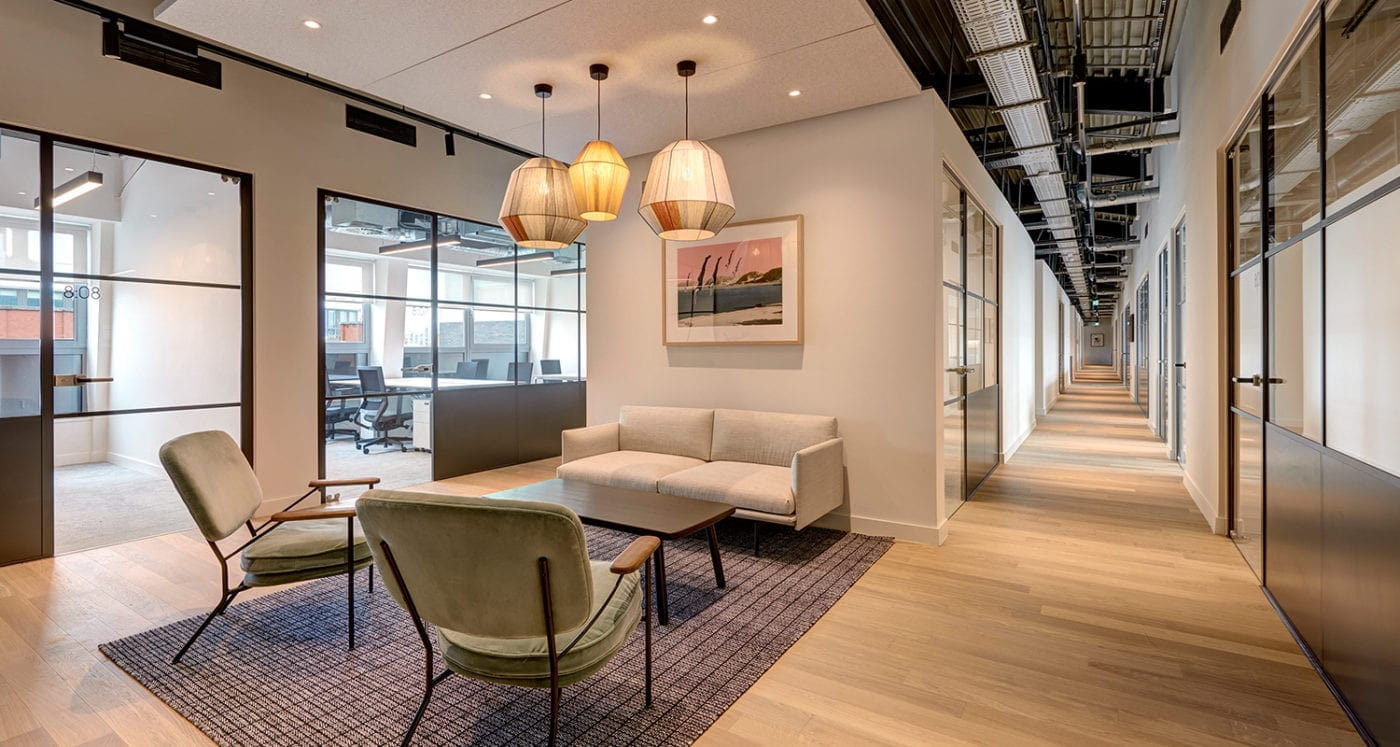
A practical guide to leasing office space in Manchester, including current costs, lease terms, deposits, break clauses and how traditional leasing compares with serviced and managed offices.
Leasing an office in Manchester can give your business greater control over its workplace, but it also usually means a longer commitment and more responsibility than taking flexible office space.
A traditional lease can look attractive because the headline rent is often lower than an all-inclusive serviced-office rate. But rent is only one part of the cost.
Business rates, service charges, fit-out, furniture, utilities, internet, cleaning, maintenance and professional fees can all sit on top.
That is why the most useful question is not simply:
How much is the rent?
It is:
What will this office actually cost us to occupy, and how certain are we that we will still need the same amount of space in a few years?
Manchester’s current flexible-office benchmark is around £400 per desk per month, while prime conventional office rent is approximately £45–£48 per sq ft per year. The two figures measure very different products, so they need to be compared using total occupancy cost rather than headline price alone.

What is a commercial office lease?
A commercial office lease is an agreement between a business and a landlord giving the company the right to occupy an office for an agreed period.
Unlike a serviced office, the tenant normally takes much more responsibility for creating and operating the workspace.
That can mean arranging the fit-out, furniture, utilities, internet, cleaning and ongoing maintenance, as well as paying business rates and service charges where applicable.
In return, your business has far greater control over the office.
You can decide how it is laid out, how it is branded and how much of the building is dedicated entirely to your team.
Commercial lease terms vary considerably. Longer leases remain common, but shorter commitments and break clauses are increasingly used to give businesses more flexibility. Government guidance notes that leases can include break clauses allowing occupiers to leave at specified points before the final expiry date. GOV.UK

Should you choose a serviced, managed or leased office?
Before starting a traditional leasing search, compare the three main private-office routes.
Serviced office
A serviced office is already furnished and ready to use.
The workspace provider usually handles furniture, internet, utilities, cleaning, maintenance and many of the wider building costs.
A realistic 2026 Manchester benchmark is around £400 per desk per month, with most mainstream serviced offices sitting between approximately £250 and £500 per desk.
Serviced offices work particularly well when your team is still growing, you need to move quickly or you do not want to commit for several years.
Managed office
A managed office gives your company a more dedicated environment with greater control over layout, meeting rooms, furniture and branding.
The operator still takes care of much of the fit-out and day-to-day property management.
This makes managed space particularly useful for scaling teams that want the office to feel like their own headquarters without taking on the full responsibility of a traditional lease.
Traditional lease
A traditional lease gives your business the highest level of control.
You rent the office directly from the landlord and take responsibility for more of the property costs and operations.
It usually becomes more attractive when headcount is predictable, the company expects to remain in the same location for several years and the business has the capital and time to create its own workplace.
For a fuller comparison, read our Serviced vs Managed vs Coworking vs Traditional Lease: Manchester Office Guide.
How much does commercial office leasing cost in Manchester?
Conventional Manchester office rent is usually quoted per square foot per year rather than per desk per month.
Prime Manchester city-centre rent was around £48 per sq ft in Q1 2026, with the wider Manchester Office Cost & Price Index using approximately £45–£48 per sq ft as a current prime range. Knight Frank UK
That is the base rent.
Your real occupancy cost may also include:
Business rates
Commercial occupiers will usually need to account for business rates separately.
The 2026 business rates revaluation came into effect on 1 April 2026. Manchester City Council currently lists the standard 2026/27 multiplier for non-retail, hospitality and leisure properties with a rateable value of £51,000 to £499,999 at 48p, with different multipliers applying at other values and for qualifying sectors.
Service charge
If you occupy part of a larger building, the landlord may recover the cost of maintaining shared areas and services through a service charge.
This can include reception, security, lifts, communal cleaning, building maintenance and other shared facilities.
Fit-out
A conventional office may need meeting rooms, partitions, kitchens, cabling, lighting, flooring and other work before it is ready for your team.
Furniture
Desks, chairs, storage, meeting-room furniture and breakout furniture may all need to be purchased separately.
Internet and technology
Connectivity, network infrastructure, access control and other technology need to be arranged.
Utilities
Electricity, water, heating and cooling may all sit outside the rent.
Cleaning and maintenance
The lease should make clear what the landlord maintains and what becomes the tenant’s responsibility.
Professional fees
Solicitors, surveyors and other advisers may be required during the transaction.
Dilapidations
Your lease may require you to repair or reinstate the office when leaving.
Businesses taking their first commercial premises regularly raise concerns about these extras. In one recent UK small-business discussion, occupiers specifically highlighted business rates, utilities, service charges and break clauses as items to check before committing.
What does a leased office actually cost compared with serviced space?
The easiest mistake is comparing a conventional rent quoted per square foot with a serviced-office rate quoted per desk.
They are not equivalent.
Imagine a 10-person Manchester business.
At Manchester’s current flexible benchmark of around £400 per desk, a serviced office would cost approximately:
10 × £400 = £4,000 per month
or:
£48,000 per year.
Now assume a conventional office allows approximately 100 sq ft for each employee once circulation, meeting rooms and supporting space are taken into account.
A 10-person team may therefore consider around:
1,000 sq ft.
At £45 per sq ft:
1,000 × £45 = £45,000 per year
or:
£3,750 per month in base rent.
At first glance, the leased office appears cheaper.
But that £3,750 does not include business rates, service charge, furniture, internet, utilities, cleaning or the cost of getting the office ready.
The serviced figure generally bundles many of those costs together.
That does not mean serviced space is always cheaper.
It means the correct comparison is total occupancy cost, not £3,750 against £4,000.
For current flexible-office costs by area and team size, see the Manchester Office Cost & Price Index 2026.
What about a 12-month Manchester office requirement?
A 12-month requirement is where traditional leasing can become difficult to justify.
Imagine the same 10-person business only needs its office for one year.
At Manchester’s £400 flexible benchmark, a serviced office would cost approximately:
£4,000 per month
or:
£48,000 over 12 months.
The office is already furnished and most of the basic workplace infrastructure is included. Manchester Offices
A 1,000 sq ft conventional office at £45 per sq ft would have a base rent of:
£45,000 for the year.
The difference is only £3,000 before adding business rates, service charge, furniture, connectivity, fit-out and professional costs.
The business also needs to consider how much of that setup expenditure can realistically be recovered after only 12 months.
For a short requirement, serviced space will therefore often provide a simpler route.
Manchester Offices says the average initial flexible workspace licence is around 12 months, with some providers allowing terms as short as one month. Some companies have moved into flexible offices within two or three days of signing, although around a month is more typical. Manchester Offices
How long are Manchester office leases?
There is no single standard lease length.
The term is negotiated between the landlord and tenant and will depend on the property, the business and the commercial deal.
Three, five and ten-year structures are common reference points in commercial property, while longer commitments still exist for larger businesses.
The more important question is how long your business can confidently predict its office requirement.
A five-year lease may be completely reasonable for an established team with stable headcount.
It is a very different commitment for a 15-person startup that could employ 40 people in two years.
RICS recommends that the heads of terms clearly record the lease length, renewal rights and any break options before the lease is drafted. RICS
How much deposit will you need for a commercial office?
Commercial rent deposits are negotiable.
Unlike residential deposits, there is no simple fixed statutory cap for ordinary commercial leases.
RICS notes that commercial rent deposits are often equivalent to around three to six months’ rent, although the amount depends on the landlord’s assessment of the tenant and the wider deal. RICS Modus
New businesses or companies with limited trading history may be asked for more security than established occupiers with strong accounts.
For example, if your annual office rent is £60,000:
Three-month deposit = £15,000
Six-month deposit = £30,000
That cash may need to be committed before you have paid for furniture, fit-out or moving costs.
First-time commercial tenants regularly underestimate this point. One UK small-business owner reported being offered a five-year lease with a three-year break but being asked for a six-month deposit because the company was new. Reddit
Ask about the deposit early rather than waiting until the lease is almost agreed.
Is the deposit the same as paying rent upfront?
No.
A rent deposit normally acts as security for the landlord.
You will still pay rent separately according to the payment terms in the lease.
The rent deposit agreement should explain how much is being held, what obligations it secures, when the landlord can use it and when it will be returned.
The RICS commercial leasing code specifically recommends that these points are clearly documented as part of the agreement. RICS
What is a break clause?
A break clause allows the landlord, tenant or both parties to end the lease at a specified point before the final expiry date.
For example:
Five-year lease
Tenant break after year three
The business could potentially leave at the third anniversary rather than remaining for the entire five years.
This can be extremely valuable when future headcount is uncertain.
But a break clause does not necessarily mean you can simply leave whenever you want.
The lease will set out the break date, the notice period and any conditions that need to be satisfied.
Government guidance confirms that the lease should state how it can be ended early, while RICS recommends that break dates, notice requirements and pre-conditions are clearly agreed in the heads of terms.
What should you check in a break clause?
The date
When can the lease actually be ended?
A break in year four provides much less protection than a break after year two if your business is changing quickly.
Notice period
How much notice must you give?
Make sure the business has the break date and notice deadline recorded well in advance.
Who can use it?
Is the break available to the tenant, the landlord or both?
Conditions
Check whether rent needs to be fully paid and whether the premises must be vacated by the break date.
RICS recommends that, unless stricter terms have already been agreed, a tenant break should generally be conditional only on basic rent being paid, the occupier giving up occupation and there being no remaining subtenants or occupiers.
RICS
How notice must be served
A break clause can contain a specific process for serving notice.
Have your solicitor review this rather than assuming an email to the landlord will be sufficient.
What other lease costs catch businesses out?
For first-time occupiers, many of the biggest surprises sit outside the rent.
Service charge
Ask how much it currently costs and exactly what it covers.
A small-business discussion about viewing premises specifically highlighted the need to ask for the service-charge budget and understand what is included.
Business rates
Do not assume the figure in an old brochure is still correct.
New rateable values came into effect on 1 April 2026, so check the current rateable value for the specific Manchester property.
Repairs
Understand whether you are responsible only for the inside of your office or for wider parts of the property.
Commercial leases can place substantial repairing obligations on tenants.
Schedule of condition
If you are taking an older office, consider whether a schedule of condition should record its state when you move in.
This can be particularly important where the lease contains repairing obligations.
Fit-out
Ask what is already installed and what the landlord expects you to add.
Reinstatement and dilapidations
Understand what needs to be removed or restored when you leave.
Recent UK small-business discussions repeatedly warn first-time tenants not to underestimate dilapidations and repair liabilities.
Utilities
Check whether electricity and other utilities are metered separately or recovered through another charge.
VAT
Confirm whether VAT is payable on the rent and service charge.
Legal and professional fees
Budget for a commercial property solicitor and potentially a surveyor.
In a 2026 small-business discussion about first-time leasing, experienced respondents strongly recommended taking legal advice rather than treating a commercial lease like a residential tenancy.

How to lease office space in Manchester
Step 1: Define what your business actually needs
Start with the company rather than the buildings.
Confirm your current headcount, expected growth, budget, working pattern and preferred Manchester locations.
Think about the maximum number of people likely to attend on a busy day.
Also decide which requirements are essential.
These might include:
- meeting rooms
- 24/7 access
- parking
- cycle storage
- showers
- client-facing reception
- private kitchens
- specialist technology
- company branding.
Avoid taking substantially more space simply because you hope to grow into it later.
Manchester Offices specifically identifies paying for unnecessary future capacity as a common mistake, particularly when flexible space allows businesses to expand gradually instead.
Step 2: Decide whether you actually need a traditional lease
Before approaching landlords, compare the lease with serviced and managed options.
Ask:
- How predictable is our headcount?
- How long do we expect to stay?
- How quickly do we need to move?
- How much control do we need over the workspace?
- How much cash are we willing to commit upfront?
If you need an office next month and your 20-person team could become 35 by next year, flexible space may be more practical.
If your business expects to stay at roughly the same size for five years and wants its own permanent Manchester headquarters, traditional leasing becomes more compelling.
Read our Serviced vs Managed vs Coworking vs Traditional Lease: Manchester Office Guide before deciding.
Step 3: Set your total office budget
Do not calculate affordability using rent alone.
Your budget should allow for:
- rent
- deposit
- business rates
- service charge
- fit-out
- furniture
- utilities
- internet
- cleaning
- maintenance
- insurance
- professional fees
- moving costs
- potential exit costs.
The combination of deposit and fit-out can create a particularly large upfront cash requirement.
A company may be able to afford the annual rent but still decide that committing tens of thousands of pounds before moving in is not the best use of its capital.
Step 4: Use a Manchester office broker
A broker can help you understand current availability and compare leased, managed and serviced options rather than approaching individual buildings one by one.
Manchester Offices says it has helped more than 10,000 businesses and works across thousands of Manchester office options. Its search service is free to businesses because office partners pay when a successful match is made.
The process starts by understanding your team size, budget and preferred location, followed by shortlisting spaces, arranging tours and supporting negotiations.
A broker can help with:
- defining your requirement
- identifying suitable Manchester areas
- comparing office models
- finding available spaces
- arranging viewings
- comparing costs
- negotiating commercial terms.
The broker does not replace a commercial property solicitor or building surveyor.
Their role is to help you understand the market and secure the right property deal.
Start your Manchester office search
Step 5: View and compare suitable offices
When viewing properties, consider how the space actually works rather than focusing only on its appearance.
Check:
- natural light
- noise
- air conditioning
- meeting-room capacity
- lifts
- security
- parking
- cycle storage
- showers
- public transport
- surrounding amenities.
Manchester businesses should also think carefully about location.
Spinningfields, the central core and premium Grade A buildings generally sit towards the higher end of the market, while Salford Quays, MediaCity and out-of-centre options can provide stronger value.
The right option is not necessarily the cheapest.
A central office may be worth more if it materially improves recruitment, attendance or client access.
Step 6: Agree the heads of terms
Heads of terms record the main commercial deal before the full lease is drafted.
These should normally cover:
- rent
- lease length
- break clauses
- deposit
- rent-free period
- service charge
- rent review
- repairing obligations
- permitted use
- fit-out responsibilities
- renewal rights.
RICS specifically recommends detailed written heads of terms so both parties understand the commitments before legal drafting begins. RICS
A lower headline rent is not always the strongest deal.
A useful break clause, rent-free period, lower deposit or contribution towards fit-out could be worth considerably more.
Step 7: Appoint a commercial property solicitor
Commercial leases contain long-term legal obligations, so professional advice is important.
Business.gov.uk recommends speaking to a solicitor before entering a commercial property agreement, particularly for longer leases.
Your solicitor can help review:
- break clauses
- repairing obligations
- service-charge wording
- rent reviews
- deposit terms
- assignment and subletting
- renewal rights
- permitted use.
You should also establish whether the lease is protected by the Landlord and Tenant Act 1954.
Many business tenancies have statutory renewal rights unless those rights are formally excluded before the lease begins. The Law Commission notes that contracting out of these protections remains common, making it important to understand the position before signing.
Step 8: Plan the fit-out and move
Once the lease is agreed, the office may still not be ready for employees.
Allow time for:
- design
- landlord approvals
- contractors
- meeting-room construction
- furniture
- power and data
- Wi-Fi
- kitchens
- branding
- access systems
- testing.
This is one of the main differences between conventional leasing and flexible workspace.
Manchester serviced offices are designed to remove most of this setup. Manchester Offices describes its plug-and-play spaces as ready from day one, with some customers able to move in within only a few days of signing.
With a lease, getting the keys can be the start of the process rather than the end.
How quickly can you move into a leased office?
A conventional lease is rarely the fastest route.
Legal work, surveys, negotiations, landlord approvals and fit-out all take time.
If speed is important, compare leased space with ready-to-use offices before deciding.
Manchester Offices says some flexible customers have moved in two or three days after signing, although closer to a month is more typical.
For a company launching a new Manchester team or reaching the end of an existing agreement, the difference can be substantial.
When should you use an office broker?
A broker can be particularly helpful when:
- this is your first Manchester office
- you are comparing several neighbourhoods
- you are unsure whether to lease or go flexible
- you need to move quickly
- you want several properties compared together
- you need current market pricing
- you want support negotiating the commercial deal.
Manchester Offices says its advisers build a picture of your requirement, source suitable options, arrange viewings and then support price negotiations before the agreement is signed.
For a simple lease renewal where you already occupy the property and know you want to stay, you may need less search support.
Professional legal and property advice can still be important.
When does a traditional Manchester office lease make sense?
A traditional lease becomes particularly attractive when your company has certainty.
It may be right when:
- headcount is relatively stable
- you plan to remain for several years
- you want complete control over the office
- the workplace needs a specific layout
- branding is important
- you have capital available for fit-out
- you can manage facilities and suppliers
- the longer move-in process is acceptable.
Manchester continues to attract businesses willing to make long-term commitments. Knight Frank notes that longer leases can signal a company’s long-term investment in the city, particularly among larger occupiers.
For a stable 100-person business, that can be entirely sensible.
For a 12-person company still hiring quickly, it may create unnecessary risk.
When is a serviced office better?
A serviced office is worth considering when:
- you need to move quickly
- headcount could change significantly
- you want to minimise upfront costs
- you prefer one monthly office bill
- you only want to commit for months rather than years
- you do not want to manage the building
- you may need to expand into another office.
Manchester’s average initial flexible licence is around 12 months, while some providers offer terms from only one month.
For a growing business, paying slightly more per month can be worthwhile if it reduces the risk of being locked into the wrong office.